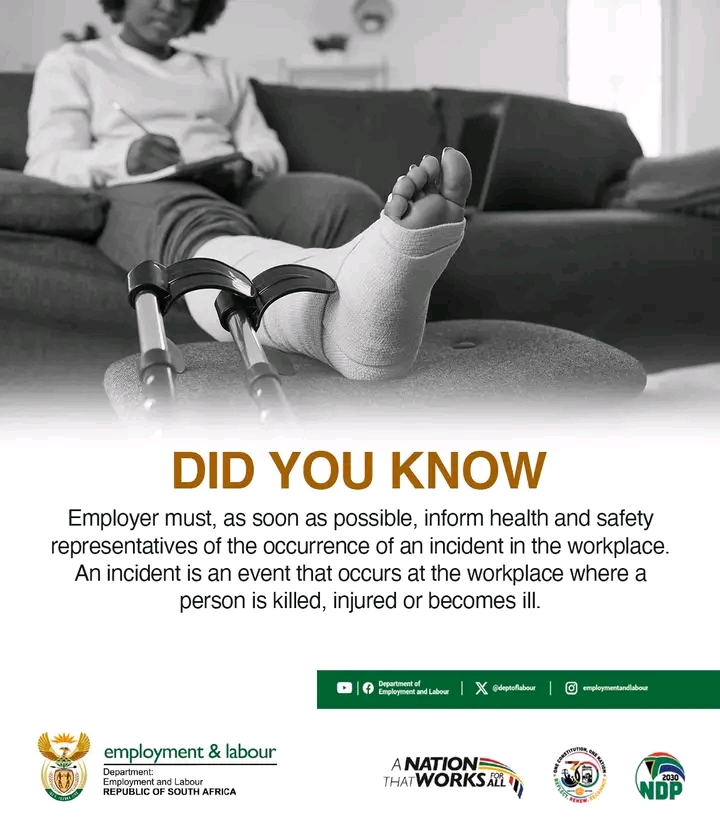
Under South Africa’s Occupational Health and Safety Act (OHS Act), employers must report any major incident, dangerous spill, or accident causing severe injury, illness, or death to a Department of Employment and Labour inspector as soon as possible.
The reporting of workplace injuries and deaths is being heavily enforced now because the landmark 2026 Compensation for Occupational Injuries and Diseases (COID) Amendment Act officially took effect, introducing severe financial penalties to replace slow-moving criminal court prosecutions.
The Department of Employment and Labour has launched a nationwide compliance crackdown driven by several critical objectives:
1. Shift to Immediate Financial Penalties Previously, failing to report an injury within the legal window was a criminal offence, but it was rarely prosecuted in court.
Under the April 2026 amendments, the Compensation Fund can now bypass the courts and impose immediate, direct administrative fines on employers. Late reporting now carries a penalty of 10% of the injured employee’s annual earnings, or potentially the full cost of the compensation claim.
2. Safeguarding Employee Claims & Medical RightsWhen employers delay reporting, the Compensation Fund stalls or denies medical coverage.
This leaves vulnerable, injured workers without the 75% temporary salary payout or free medical aid they are legally owed. If an employer misses the 7-day accident reporting window, they become personally liable for the worker’s entire medical bill.
3. Expanded Employer Liability for Traumatic IncidentsThe legal definitions of what employers are responsible for changed significantly in 2026:PTSD is now an occupational disease:
Post-Traumatic Stress Disorder is formally covered. If an employee experiences a traumatic workplace event (like a violent robbery or witnessing a fatal accident), the employer must report it within 14 days of diagnosis.
Work Transport: Employers are now liable for injuries that happen during company-arranged transportation.
4. Shifting to Rehabilitation and Reintegration: The government wants to change the corporate mindset from simply paying out injury claims to actively bringing injured workers back into the economy.
Employers are now legally mandated to facilitate rehabilitation, transitional work, and reasonable accommodations to get injured staff back to work, with financial rebates given to compliant businesses.
NB: If an employer fails to report an employee’s workplace injury or death, they face a severe combination of immediate administrative fines, full personal financial liability for medical bills, and potential criminal prosecution.
Such following would follow if Employer doesn’t comply with the rules set by Department of Employment and Labour:
The Compensation Fund can bypass slow criminal courts and issue direct administrative penalties. Missing the 7-day window to report an injury or accident results in an automatic penalty of up to 10% of the company’s actual or estimated annual earnings for that financial year.
Normally, the Compensation Fund covers 100% of an injured worker’s medical costs for up to two years. If the employer refuses to report the accident or fails to submit the W.Cl.2 (Employer’s Report of Accident) form:
The employer becomes personally liable to pay the doctor, hospital, and specialist bills out of pocket.
The employer must pay double the amount of the employee’s three months of temporary total disablement compensation if they stall payouts.
The full cost of emergency transport (ambulance or transit to the hospital) is billed directly to the non-compliant employer.
Deliberately hiding, delaying, or refusing to report an injury on duty is a statutory criminal offence.
Business owners, CEOs, directors, and responsible managers can face criminal charges under the OHS Act and COIDA, which carry sentences of up to 12 months in prison per incident.
Section 35 of COIDA normally protects compliant employers from being sued in civil court by their workers for negligence.
However, if an employer fails to report the accident or register with the fund, the employee or their grieving family can launch a massive civil lawsuit directly against the business for damages, pain, suffering, and loss of life.
An employer cannot hide an accident by refusing to file paperwork. Employees have the legal right to report the incident directly to a Department of Employment and Labour inspector.
A direct worker report triggers an immediate, hostile Department of Labour workplace audit, freezing operations until the investigation is complete.
BY LUCKY SEANEGO